I listened to this song tonight -- in a different version that I can't find online -- and I thought, because of its topic, it was relevant for this site (not least since it also comes from the late 1920s).
(With a reminder, of course, that the woman at the heart of The Most Remarkable Woman in England was found not guilty.)
"To Keep My Love Alive" (Rogers and Hart), sung by Mary Testa
Sunday 10 January 2016

Monday 13 October 2014
Special issue: Crime Stories
The events of the Pace case occurred within the context of inter-war British crime, media and police history, the study of which has been rapidly expanding in recent years.
I am very pleased to be able to announce that a special issue of Media History edited by myself and Paul Knepper -- "Criminality, Policing and the Press in Inter-war European and Transatlantic Perspectives" -- has now left the printers (which I can confirm since I received my copy today).
The four main articles (access to which will require an institutional subscription, probably through a university) consider a variety of topics:
 In "Rogues of the Racecourse: Racing Men and the Press in Interwar Britain", Heather Shore (Leeds
Metropolitan) considers the often dramatic (and sometimes violent)
world of racecourse gangs and their presentation in both the serious and
sensationalist newspaper press. (Among those gangs considered in the
article are then then-infamous Sabinis, who have featured recently in
fictional form in the hit British television show Peaky Blinders.)
In "Rogues of the Racecourse: Racing Men and the Press in Interwar Britain", Heather Shore (Leeds
Metropolitan) considers the often dramatic (and sometimes violent)
world of racecourse gangs and their presentation in both the serious and
sensationalist newspaper press. (Among those gangs considered in the
article are then then-infamous Sabinis, who have featured recently in
fictional form in the hit British television show Peaky Blinders.)
In "Two Suspicious Persons: Norwegian Narratives and Images of a Police Murder Case, 1926-1950", Per Jørgen Ystehede (University of Oslo) takes a cross-media look at a case of police murder that, although legendary within Norway, has yet to be given the attention it deserves outside of that national context. Featuring stills from the 1949 feature film based on the case (which was banned in 1952 and not shown again until 2007), the article locates the Norwegian discourse around the case both within national and broader European trends involving perceptions of crime.
 My own article, "The Constables and the 'Garage Girl': The Police, the Press, and the Case of Helene Adele",
considers the controversy that arose when two London Metropolitan
Police constables arrested a young woman for alleged disorder in the
summer of 1928. She accused the constables of attempting to sexually
assault her and use false charges to discredit her story, leading to a
trial (and the eventual conviction) of the two men. Placed within the
context of the period's sensationalist press and a long series of police
scandals, the case has much to say about the complexities of "human
interest" journalism in the 1920s.
My own article, "The Constables and the 'Garage Girl': The Police, the Press, and the Case of Helene Adele",
considers the controversy that arose when two London Metropolitan
Police constables arrested a young woman for alleged disorder in the
summer of 1928. She accused the constables of attempting to sexually
assault her and use false charges to discredit her story, leading to a
trial (and the eventual conviction) of the two men. Placed within the
context of the period's sensationalist press and a long series of police
scandals, the case has much to say about the complexities of "human
interest" journalism in the 1920s.
.jpg) Paul Knepper (University of Sheffield), in "International Criminals: The League of Nations, the Traffic in Women and the Press", explores one
of the lesser known aspects of the League's activities in the inter-war
period: the campaign against the traffic in women (previously known as
"white slavery"). An important stage in the evolution of the modern
language of "human trafficking", the League's investigations and reports
were not only given widespread coverage but served as an important
justification for the international organisation's existence.
Paul Knepper (University of Sheffield), in "International Criminals: The League of Nations, the Traffic in Women and the Press", explores one
of the lesser known aspects of the League's activities in the inter-war
period: the campaign against the traffic in women (previously known as
"white slavery"). An important stage in the evolution of the modern
language of "human trafficking", the League's investigations and reports
were not only given widespread coverage but served as an important
justification for the international organisation's existence.
In addition, Paul and I present an introductory essay (access to this is FREE) that explores some European and transatlantic contexts of recent crime-and-media historiography, which has--certainly for the inter-war period--become a very active field in recent years.
The special issue had its origins in a session of the 2012 European Social Science History Conference in Glasgow that I organised, though there have been a few twists and turns since then.
It has been a great experience to work with such talented colleagues who are, truly, not only engaged in some fascinating research but also capable of framing their work in clear and vivid language.
Furthermore, it was a very positive experience working with Media History, and we are all quite happy with the result.
Should anyone be interested in a copy of these essays but not have access to them through their institution, please do contact me. (Drafts of the introductory essay and my own article are available via my academia.edu page).
[Cross-posted at Obscene Desserts]
I am very pleased to be able to announce that a special issue of Media History edited by myself and Paul Knepper -- "Criminality, Policing and the Press in Inter-war European and Transatlantic Perspectives" -- has now left the printers (which I can confirm since I received my copy today).
The four main articles (access to which will require an institutional subscription, probably through a university) consider a variety of topics:
In "Two Suspicious Persons: Norwegian Narratives and Images of a Police Murder Case, 1926-1950", Per Jørgen Ystehede (University of Oslo) takes a cross-media look at a case of police murder that, although legendary within Norway, has yet to be given the attention it deserves outside of that national context. Featuring stills from the 1949 feature film based on the case (which was banned in 1952 and not shown again until 2007), the article locates the Norwegian discourse around the case both within national and broader European trends involving perceptions of crime.
 Paul Knepper (University of Sheffield), in "International Criminals: The League of Nations, the Traffic in Women and the Press", explores one
of the lesser known aspects of the League's activities in the inter-war
period: the campaign against the traffic in women (previously known as
"white slavery"). An important stage in the evolution of the modern
language of "human trafficking", the League's investigations and reports
were not only given widespread coverage but served as an important
justification for the international organisation's existence.
Paul Knepper (University of Sheffield), in "International Criminals: The League of Nations, the Traffic in Women and the Press", explores one
of the lesser known aspects of the League's activities in the inter-war
period: the campaign against the traffic in women (previously known as
"white slavery"). An important stage in the evolution of the modern
language of "human trafficking", the League's investigations and reports
were not only given widespread coverage but served as an important
justification for the international organisation's existence.In addition, Paul and I present an introductory essay (access to this is FREE) that explores some European and transatlantic contexts of recent crime-and-media historiography, which has--certainly for the inter-war period--become a very active field in recent years.
The special issue had its origins in a session of the 2012 European Social Science History Conference in Glasgow that I organised, though there have been a few twists and turns since then.
It has been a great experience to work with such talented colleagues who are, truly, not only engaged in some fascinating research but also capable of framing their work in clear and vivid language.
Furthermore, it was a very positive experience working with Media History, and we are all quite happy with the result.
Should anyone be interested in a copy of these essays but not have access to them through their institution, please do contact me. (Drafts of the introductory essay and my own article are available via my academia.edu page).
[Cross-posted at Obscene Desserts]
Monday 28 July 2014
"Quite simply an absorbing read"
The June issue of the English Historical Review contains a very fine review of The Most Remarkable Woman in England which is all the more enjoyable because it was written by Adrian Bingham,
who is not only one of the leading historians of the twentieth-century
British press but also someone whose own work influenced my approach to some
of the topics in my book on the Pace murder trial.
I'm particularly pleased by the review as it is attentive to a difficult problem with which I wrestled throughout the more than five years I spent researching and writing the book: how to combine an exciting story that would appeal to as broad an audience as possible (essentially anyone who is interested in real-life human drama and not overly averse to endnotes) while also maintaining enough academic street cred for my professional historian peers to still take it seriously.
Or, as Bingham puts it in his review:
Happily, he finds that I have succeeded in this effort:
At the end, Bingham raises a potential problem that was always on my mind (and which plagued my efforts to publish the book until I made contact with the wonderful people at Manchester University Press):
However, there's a very happy ending:
It goes without saying, I suppose, that I do too.
I've had a fairly detailed look at reviews of the book at this blog, and there is also a shorter and more concise reviews page if you just want to skim all the nice things that people have been saying about it.
And if you feel so inclined, please do order The Most Remarkable Woman in England from your local bookstore, from Manchester University Press or from the online retailer of your choice.
Rumour has it that you may be glad you did.
I'm particularly pleased by the review as it is attentive to a difficult problem with which I wrestled throughout the more than five years I spent researching and writing the book: how to combine an exciting story that would appeal to as broad an audience as possible (essentially anyone who is interested in real-life human drama and not overly averse to endnotes) while also maintaining enough academic street cred for my professional historian peers to still take it seriously.
Or, as Bingham puts it in his review:
What is the best way for academic historians to broaden their audience? How should they reach out to the much-sought-after ‘general reader’? One option (the Niall Ferguson or Simon Schama route) is to produce bold grand narratives and dazzle the public with new ways of looking at the ‘big picture’. An alternative, pursued here by John Carter Wood, is to narrow the scale, and to focus upon a dramatic human story, which can then be used to illuminate the period in question.
Happily, he finds that I have succeeded in this effort:
The spectacular success of Kate Summerscale’s The Suspicions of Mr Whicher (2009), based on a murder mystery that unfolded in Wiltshire in 1860, seems to have created a demand for real-life historical detective stories, and Wood has produced a pacy, scholarly and thought-provoking contribution to the genre. ...
Although this book is clearly designed to appeal beyond the academy, it will be of interest to scholars.... Firstly, it is quite simply an absorbing read. The case itself is a fascinating one, and Wood does it full justice. He writes crisply and vividly, and shows a real empathy for his protagonists, teasing out the likely motivations for their actions.... He has clearly learned well from the crime novelists, such as Agatha Christie and Dorothy Sayers, who so entertained the British public in the 1920s.
At the end, Bingham raises a potential problem that was always on my mind (and which plagued my efforts to publish the book until I made contact with the wonderful people at Manchester University Press):
There is a danger that books like this may fall between two stools. Wood is far more measured in his approach than a writer such as Summerscale, and he is too scrupulous a historian to let his imagination take him further than the evidence allows in order to entertain the reader. At the same time, some of those working in the field would undoubtedly have been interested in seeing some of the underlying themes developed further.
However, there's a very happy ending:
On its own terms, though, as a forensic historical examination of one of the decade’s most intriguing murder cases, this is an undoubted success. I hope it gets the wider readership it deserves.
It goes without saying, I suppose, that I do too.
I've had a fairly detailed look at reviews of the book at this blog, and there is also a shorter and more concise reviews page if you just want to skim all the nice things that people have been saying about it.
And if you feel so inclined, please do order The Most Remarkable Woman in England from your local bookstore, from Manchester University Press or from the online retailer of your choice.
Rumour has it that you may be glad you did.
Friday 9 May 2014
"A murder mystery that captivated the nation"
Academic reviews, by nature, take a little while to start appearing.
I've already noted a few reviews from history journals of my last book, The Most Remarkable Woman in England: Poison, Celebrity and the Trials of Beatrice Pace which appeared at the end of last year. I've just noted that two others have appeared.
Happily, they both say very nice things about the book, though they focus on different things.
In Women's History Review, a review by Caitriona Clear is currently appearing as 'advance access' online (meaning that it hasn't yet appeared in the print version).
Clear focuses on, and largely summarises, the dramatic story aspects of the Pace case. She calls the book a 'page-turner' and observes:
Clear, however, finds my suggestion that Harry Pace may have killed himself via arsenic poisoning to be 'baffling'.
My actual argument about Harry's death is a bit different than she describes; however, this is one of those things where I would definitely encourage people to read the book and make up their own minds.
In the current issue of Crime, Media, Culture, Lucy Williams (who is herself a specialist on the history of women and crime) writes:
Many thanks to both reviewers for the careful readings and positive verdicts.
A complete list of reviews can be found here.
I've already noted a few reviews from history journals of my last book, The Most Remarkable Woman in England: Poison, Celebrity and the Trials of Beatrice Pace which appeared at the end of last year. I've just noted that two others have appeared.
Happily, they both say very nice things about the book, though they focus on different things.
In Women's History Review, a review by Caitriona Clear is currently appearing as 'advance access' online (meaning that it hasn't yet appeared in the print version).
Clear focuses on, and largely summarises, the dramatic story aspects of the Pace case. She calls the book a 'page-turner' and observes:
In telling this story, [Wood] references all the main authorities and rehearses all the arguments of gender history and British social history in the inter-war period. He does this so skilfully that there is no sense of being dragged away from the scene of the crime to listen to teacher. Nor does he shy away from speculating about what really happened to Harry Pace.
Clear, however, finds my suggestion that Harry Pace may have killed himself via arsenic poisoning to be 'baffling'.
My actual argument about Harry's death is a bit different than she describes; however, this is one of those things where I would definitely encourage people to read the book and make up their own minds.
In the current issue of Crime, Media, Culture, Lucy Williams (who is herself a specialist on the history of women and crime) writes:
John Carter Wood's The Most Remarkable Woman in England may at first seem little more than historical coverage of a real-life whodunit mystery, but this impressive scholarly work quickly shows the trial of Beatrice Pace to be a landmark court case--socially, culturally, and legally. ...
In a fascinating display of meticulously collected evidence, Wood at first draws the reader in to ask 'who killed Harry Pace?', but the real triumph of this book is the seamless way in which the author unravels the social and cultural impact of the case as the evidence and hearsay surrounding the murder mounted.
Quickly, The Most Remarkable Woman in England becomes not about the guilt or innocence of Beatrice Pace in the death of her husband, but a series of more complex questions for the reader to consider. These relate both to situating the case as a product of its time and in thus reading its significance, and also in evaluating the role which the media played in constructing well-defined personae for both harry and Beatrice Pace, as well as the extent to which this influenced public reaction to the trial. ...
In analysing the Pace case, John Carter Wood offers an in-depth exploration of attitudes towards inter-war crime, gender, media sensation and criminal justice, and at the same time delivers a comprehensive overview of a murder mystery that captivated the nation.
Many thanks to both reviewers for the careful readings and positive verdicts.
A complete list of reviews can be found here.
Saturday 1 February 2014
Own a piece of Pace-case history...for only about £3 million
It has been announced that Gloucester Prison is now up for sale.
As the Gloucester Citizen reported today:
Among other illustrious guests, Beatrice Pace was held in the prison during her trial in Gloucester in July 1928.
Here is an aerial image of the prison, coincidentally also taken in 1928, which also shows the Shire Hall, where the trial was held.
It's certainly a rather different way of getting on the property ladder.
As the Gloucester Citizen reported today:
As a 3.5-acre brownfield site it could be worth more than £3million but its unique character could drive the price down – 122 bodies lie beneath it and its uses could be constrained by its history.
The Debtors’ Prison became a cell block on the west side and is Grade II listed, meaning the interior is protected too.
The oldest part, which retains features from the 1791 prison, is also listed.
Among other illustrious guests, Beatrice Pace was held in the prison during her trial in Gloucester in July 1928.
Here is an aerial image of the prison, coincidentally also taken in 1928, which also shows the Shire Hall, where the trial was held.
 |
| Source: Britain from Above |
It's certainly a rather different way of getting on the property ladder.
Saturday 21 December 2013
The Twelve Reviews of Christmas, part 12
Concluding my pre-Christmas round-up of reviews of my book over the past year or so...
There has been no particular ranking of the reviews in this list; however, the excellent review The Most Remarkable Woman in England received from Tessa Hadley at the Guardian is one of my favourites.
This is not only because it was a particularly high profile positive review, but also because Hadley praised precisely some of the things that worked very hard to achieve in the book, such as capturing both a sense of drama and the authentic details of the language used by various figures in the case.
It really is hard for me to imagine a better opening line to a review of my book:
I mean...really. That's a great start.
And then it just gets better from there:
The rest of the review is very well worth reading.
Perhaps it -- or the other reviews that I've considered in this series -- will convince you to take a closer look at The Most Remarkable Woman in England.
And whether you do or don't: Merry Christmas!
There has been no particular ranking of the reviews in this list; however, the excellent review The Most Remarkable Woman in England received from Tessa Hadley at the Guardian is one of my favourites.
This is not only because it was a particularly high profile positive review, but also because Hadley praised precisely some of the things that worked very hard to achieve in the book, such as capturing both a sense of drama and the authentic details of the language used by various figures in the case.
 |
| The image of the crowd outside the Pace trial used in the Guardian review |
It really is hard for me to imagine a better opening line to a review of my book:
'Sometimes life is better than fiction.'
I mean...really. That's a great start.
And then it just gets better from there:
'Is there any novelist who could have got this extraordinary story so perfectly right, inventing it: the violence at the heart of it, the suspense, the succession of revelations, the passions so raw and inchoate that they have a mythic force? And then there's the grand sweep of the narrative, beginning in the bleak poverty of an obscure cottage in the Forest of Dean, acted out finally on the national stage. [...] John Carter Wood's book about the Pace trial works because of his sober and scrupulous assembly of the evidence, quoting the words that were spoken and written at the time so we can feel the textures of the material for ourselves – the found poetry of precise reportage.'
The rest of the review is very well worth reading.
Perhaps it -- or the other reviews that I've considered in this series -- will convince you to take a closer look at The Most Remarkable Woman in England.
And whether you do or don't: Merry Christmas!
Friday 20 December 2013
The Twelve Reviews of Christmas, part 11
One of the highlights of the period shortly after the publication of The Most Remarkable Woman in England last year was being interviewed on BBC Radio 4's venerable show 'Woman's Hour'.
I had never previously been interviewed on radio before (though there were several years in an earlier life when I had radio shows of my own on minor, local stations, but that's another story).
Moreover, it was certainly exciting to actually enter what has long been one of my favourite buildings in London: Broadcasting House.
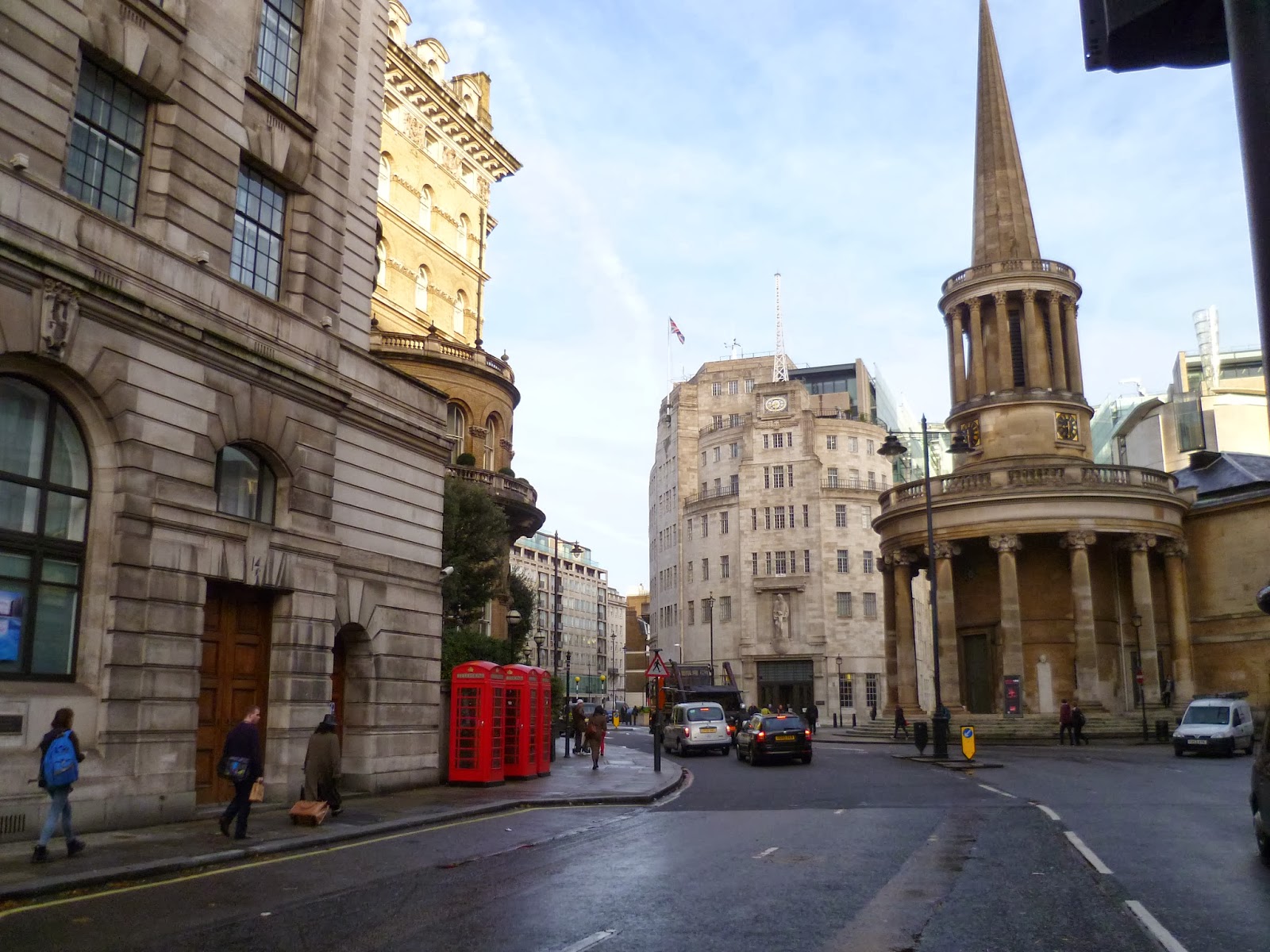
Although there had been some preparatory discussion with the show's producers about possible topics, I went into the interview with Jenni Murray without really knowing what I would be asked.
So I was certainly fairly keyed up when I got into the studio.
Jenni Murray, though, is a very skilled interviewer: although she makes it seem easy, she manages to ask very well crafted questions and to subtly shape the discussion.
As interviewee, I had the sense of being offered a very well-defined space to fill. This all helped me to stay succinct and not begin endlessly waffling on, as is occasionally...well, OK, often...my wont.
As to the interview, you can judge for yourself: my segment is still available from the BBC Radio 4 website.

In the brief period of time we had to chat after the interview, Jenni said some very nice things to me about the book. I asked later whether she might be willing to make a public summary of those statements, and she agreed.
So, she described The Most Remarkable Woman as:
The whole experience was very rewarding (also for getting the chance to chat with Martha Wainwright who gave a live performance on that show); the same can be said about my second BBC interview, with Anna King for BBC Radio Gloucestershire.
Sadly, though, that one is no longer online.
So if you can't quite get enough of hearing my voice, I suppose you're out of luck.
I had never previously been interviewed on radio before (though there were several years in an earlier life when I had radio shows of my own on minor, local stations, but that's another story).
Moreover, it was certainly exciting to actually enter what has long been one of my favourite buildings in London: Broadcasting House.
Although there had been some preparatory discussion with the show's producers about possible topics, I went into the interview with Jenni Murray without really knowing what I would be asked.
So I was certainly fairly keyed up when I got into the studio.
Jenni Murray, though, is a very skilled interviewer: although she makes it seem easy, she manages to ask very well crafted questions and to subtly shape the discussion.
As interviewee, I had the sense of being offered a very well-defined space to fill. This all helped me to stay succinct and not begin endlessly waffling on, as is occasionally...well, OK, often...my wont.
As to the interview, you can judge for yourself: my segment is still available from the BBC Radio 4 website.
In the brief period of time we had to chat after the interview, Jenni said some very nice things to me about the book. I asked later whether she might be willing to make a public summary of those statements, and she agreed.
So, she described The Most Remarkable Woman as:
'A fascinating analysis of one woman's domestic disaster, the power of the press and public opinion. Loved it!'
The whole experience was very rewarding (also for getting the chance to chat with Martha Wainwright who gave a live performance on that show); the same can be said about my second BBC interview, with Anna King for BBC Radio Gloucestershire.
Sadly, though, that one is no longer online.
So if you can't quite get enough of hearing my voice, I suppose you're out of luck.
The Twelve Reviews of Christmas, part 10
Continuing my pre-Christmas round-up of reviews of my book over the past year...
Another one of the more academic reviews of The Most Remarkable Woman in England appeared at the open-access crime history journal Law, Crime and History.
There, Tony Ward opened his review of my book with a striking comparison to a television crime drama:
Ward concludes:
Another one of the more academic reviews of The Most Remarkable Woman in England appeared at the open-access crime history journal Law, Crime and History.
There, Tony Ward opened his review of my book with a striking comparison to a television crime drama:
I started reading this book on the evening when the TV crime drama Broadchurch reached its finale, and the parallels are readily apparent: a suspicious death in a small community brings family conflicts to the surface, rumours abound, an arrogant policeman from London comes to investigate, the national press scent a good story, and the family of the deceased find themselves briefly famous.
Ward concludes:
The Most Remarkable Woman in England is a scholarly book and Wood resists any temptation to ‘solve’ the case, though he argues that the suicide theory was plausible and Beatrice was rightly acquitted. He urges historians to take ‘into account both those women who were demonised by the public and unfairly condemned and those who received public support and were – all things considered – treated fairly’ (195). In this respect his work usefully complements studies of women convicted of murder, such as Anette Balinger’s Dead Woman Walking (2000). But if one sees early twentieth century murder trials as a kind of morality play in which the moral invariably serves to reinforce the subordination of women, Beatrice Pace’s trial fits the mould as well as any of those that sent women to the gallows. -- Law, Crime and History, 3.2 (2013), 193-94. (PDF version of the full review)
Thursday 19 December 2013
The Twelve Reviews of Christmas, part 9
Continuing my pre-Christmas round-up of reviews of my book over the past year...
The issue of attitudes toward gender in the 1920s is a central issue in The Most Remarkable Woman in England, hence it's been gratifying to see the book receiving positive comments from historians experienced in that field.
At Gender & History, Gwyneth Nair (co-author of a book on the Victorian poisoning murder trial of Madeleine Smith) thought that the book could have emphasised analysis more than narrative, and she suggests that I might have made more comparisons of the Pace case with even more trials of women than I do.
Nonetheless, she concludes that The Most Remarkable Woman in England is
I hope to have more to say about the issue of inter-war gender, as I'm currently reading Lucy Bland's fascinating book Modern Women on Trial.
We'll see how the Christmas season goes, time-wise....
The issue of attitudes toward gender in the 1920s is a central issue in The Most Remarkable Woman in England, hence it's been gratifying to see the book receiving positive comments from historians experienced in that field.
At Gender & History, Gwyneth Nair (co-author of a book on the Victorian poisoning murder trial of Madeleine Smith) thought that the book could have emphasised analysis more than narrative, and she suggests that I might have made more comparisons of the Pace case with even more trials of women than I do.
Nonetheless, she concludes that The Most Remarkable Woman in England is
'a thoughtful, readable account of an intriguing case, and has valuable things to say about the nature of interwar English society.' (Gender & History, 25.2 (2013), 385-86.)
I hope to have more to say about the issue of inter-war gender, as I'm currently reading Lucy Bland's fascinating book Modern Women on Trial.
We'll see how the Christmas season goes, time-wise....
Wednesday 18 December 2013
The Twelve Reviews of Christmas, part 8.
Among the various academic reviews that have appeared of The Most Remarkable Woman in England, that by Matthew Houlbrook was especially nice:
I've never met Matthew, but he's the author of some excellent things about crime, media and sexuality in early twentieth-century Britain, so he knows whereof he speaks.
What became known as the ‘Fetter Hill mystery’ was one of the most sensational criminal cases of the 1920s. Then ‘still relatively new’, the media frenzy that surrounded Beatrice Pace allows John Carter Wood to tease out an engaging and suggestive analysis of the relationship between crime, culture, and politics in a formative historical period (5). The Most Remarkable Woman in England draws on an impressive body of archival research: an extensive survey of local and national newspapers, records of courts, coroners, and police, and (most strikingly) the hundreds of letters Pace received from her supporters at the trial’s conclusion. The result is a rich and textured archeology of a case that unfolded as much through new forms of mass media as the institutions of criminal justice. If the detail sometimes becomes overwhelming, it is hard to imagine a more thorough account of the processes through which crime became news. (Media History, 19.3 (2013), 391-92.)
I've never met Matthew, but he's the author of some excellent things about crime, media and sexuality in early twentieth-century Britain, so he knows whereof he speaks.
Tuesday 17 December 2013
The Twelve Reviews of Christmas, part 7
Among the positive reviews The Most Remarkable Woman in England received was one in the Literary Review from historian Dominic Sandbrook (probably known best recently for his books on 1970s Britain and a number of BBC television documentaries).
There is no version of it online, however, I have a few excerpts below.
Among other things Sandbrook observes:
'Decide for yourself.' Hmm. Sounds about right.
And I believe there is a holiday coming.
(Quotes from the Dec-Jan 2012/13 issue of the Literary Review.)
There is no version of it online, however, I have a few excerpts below.
Among other things Sandbrook observes:
Today, of course, Beatrice Pace is almost completely forgotten. It is to John Carter Wood’s credit, therefore, that in this splendid piece of historical detective work he not only brings her story alive but casts new light on the life of England in the 1920s, a land desperate to return to normality after the First World War, but terrified of the demons lurking in the attic.
[...]
Like Kate Summerscale’s prizewinning book The Suspicions of Mr Whicher, Wood’s account is an engrossing exercise in historical reconstruction, slowly peeling back layer upon layer of the story of Harry and Beatrice Pace.
[...]
Wood’s achievement is to use the case to explore the troubled world of the mid-1920s, a period when, as the Daily Herald remarked, ‘nine people out of ten follow the meagre official details and the billowing rumours of an actual murder mystery more eagerly and breathlessly than the most devoted detective “fan.”’
[...]
Wood thinks the jury came to the right verdict, though it is a measure of his immaculately researched, fluently written and utterly compelling book that he allows readers to come to their own conclusions. For my own part, I rather think there was more to Beatrice Pace than met the eye. Who really killed Harry Pace? You had better read the book and decide for yourself.
'Decide for yourself.' Hmm. Sounds about right.
And I believe there is a holiday coming.
(Quotes from the Dec-Jan 2012/13 issue of the Literary Review.)
Friday 13 December 2013
The Twelve Reviews of Christmas, part 6
Continuing my pre-Christmas round-up of reviews of my book over the past year...
A couple of very positive things were said about the book even before it was actually published: in the 'blurbs' that were gained by sending out a pre-publication version of the main text to a couple of experts in the field.
So, while they're not technically 'reviews' they certainly have review-like qualities and, in a spirit of Christmas generosity, can be included here.
The two back-of-the-book blurbs we succeeded in getting were from two renowned historians, Clive Emsley (Professor Emeritus of History at the Open University) and Joanna Bourke (Professor of History at Birkbeck College).
I happened to meet Joanna for the first time in 2007 when I was actually giving one of the very first conference papers based upon my then still quite early research into the Pace murder trial. She was enthusiastic about the story from the beginning, becoming one of the many people who were very encouraging along the (long) way from the start of the project to publication.
For her blurb, she wrote:
For anyone interested in crime and policing history, Clive of course needs no introduction. (You can find a review of his latest book -- on the history of crime and the British military -- here.) And he also said some characteristically kind things about my book:
High praise indeed from someone whose work has been influential on my own development as a historian of crime and justice.
Clive also very generously gave a speech at the shared book launch event for The Most Remarkable Woman in England and two other crime-history related titles from Manchester University Press last year.
Seems like ages ago now, but it was only last year...
A couple of very positive things were said about the book even before it was actually published: in the 'blurbs' that were gained by sending out a pre-publication version of the main text to a couple of experts in the field.
So, while they're not technically 'reviews' they certainly have review-like qualities and, in a spirit of Christmas generosity, can be included here.
The two back-of-the-book blurbs we succeeded in getting were from two renowned historians, Clive Emsley (Professor Emeritus of History at the Open University) and Joanna Bourke (Professor of History at Birkbeck College).
I happened to meet Joanna for the first time in 2007 when I was actually giving one of the very first conference papers based upon my then still quite early research into the Pace murder trial. She was enthusiastic about the story from the beginning, becoming one of the many people who were very encouraging along the (long) way from the start of the project to publication.
For her blurb, she wrote:
'This is history as murder-mystery. John Carter Wood tells a spellbinding story of murder, using the trials of the accused (Beatrice Pace) to reflect the nature of celebrity culture, the legal system, and gender relations in 1920s Britain. The fundamental question remains: did Beatrice Pace kill her husband? You will have to read the book to find out!'
For anyone interested in crime and policing history, Clive of course needs no introduction. (You can find a review of his latest book -- on the history of crime and the British military -- here.) And he also said some characteristically kind things about my book:
'The trial of Beatrice Pace was one of the most sensational news stories in inter-war Britain. In this thoroughly researched and clearly-argued study, John Carter Wood is not solely concerned with the usual question of whether or not Mrs Pace was guilty. Rather he also focuses on the period's celebrity culture, the role of the press, the development of public interest and the police. In so doing, he has produced a model for modern social and cultural historians.'
High praise indeed from someone whose work has been influential on my own development as a historian of crime and justice.
Clive also very generously gave a speech at the shared book launch event for The Most Remarkable Woman in England and two other crime-history related titles from Manchester University Press last year.
Seems like ages ago now, but it was only last year...
Thursday 12 December 2013
The Twelve Reviews of Christmas, part 5
Continuing my pre-Christmas round-up of reviews of my book over the past year...
While there's something great about all positive reviews, of course, getting them from friends is even nicer.
And it's hardly as if that's a foregone conclusion: among academics, sometimes your friends can be your worst critics.
So it was a relief to see Andrew Hammel's Amazon.co.uk review not only so positive but also so clear about why it was positive:
Andrew's own book -- Ending the Death Penalty: The European Experience in Global Perspective -- is also 'highly recommended' if I do say so myself.
As is his blog.
While there's something great about all positive reviews, of course, getting them from friends is even nicer.
And it's hardly as if that's a foregone conclusion: among academics, sometimes your friends can be your worst critics.
So it was a relief to see Andrew Hammel's Amazon.co.uk review not only so positive but also so clear about why it was positive:
Yet the Pace case was more than a headline-grabber. The long interrogations of Mrs. Pace prompted outrage at Scotland Yard's 'third-degree' tactics, contributing to an emerging wave of civil-rights activism in 1920s England. The trial also highlighted the binds of economic dependence and discrimination which kept working-class women trapped in abusive marriages. John Carter Wood writes with verve and elegance, weaving insights into the broader social ramifications of this trial without losing the thread courtroom drama that makes the book such a compelling read. He has also done much original research, clearing up questions that previous accounts left unanswered and providing dozens of illustrations, some of which have come from previously-inaccessible private archives. The result is a vivid portrayal not just of one woman's fate, but of a society in transition. Highly recommended!
Andrew's own book -- Ending the Death Penalty: The European Experience in Global Perspective -- is also 'highly recommended' if I do say so myself.
As is his blog.
Wednesday 11 December 2013
The Twelve Reviews of Christmas, part 4
Continuing my pre-Christmas round-up of reviews of my book over the past year...
The shortest comment in the Twelve Reviews of Christmas appeared, appropriately enough, on Twitter not long after The Most Remarkable Woman in England appeared.
It was written by Harvard psychology professor, Steven Pinker, who tweeted:
I had had the great pleasure of being able to tell Steve (quite extensively) about the case and my research into it in person when we met at a violence history conference in Switzerland the year before that.
We had come to know each other starting in about 2007 via an extensive email correspondence while he was working on his bestselling book The Better Angels of Our Nature, a signed copy of which arrived here shortly after the conference.
I was therefore very pleased to be able to give him a copy of The Most Remarkable Woman in England in return.
It's not every day, after all, that your book gets recommended by one of the world's leading thinkers.
The shortest comment in the Twelve Reviews of Christmas appeared, appropriately enough, on Twitter not long after The Most Remarkable Woman in England appeared.
It was written by Harvard psychology professor, Steven Pinker, who tweeted:
'A fascinating real-life murder story: John Carter Wood's The Most Remarkable Woman in England.'
I had had the great pleasure of being able to tell Steve (quite extensively) about the case and my research into it in person when we met at a violence history conference in Switzerland the year before that.
We had come to know each other starting in about 2007 via an extensive email correspondence while he was working on his bestselling book The Better Angels of Our Nature, a signed copy of which arrived here shortly after the conference.
I was therefore very pleased to be able to give him a copy of The Most Remarkable Woman in England in return.
It's not every day, after all, that your book gets recommended by one of the world's leading thinkers.
Tuesday 10 December 2013
The Twelve Reviews of Christmas, part 3
Continuing my pre-Christmas round-up of reviews of my book over the past year...
One of my favourite comments about the book came unexpectedly shortly before last Christmas, when crime novelist Nicola Upson selected The Most Remarkable Woman in England as her 'favourite crime book of the year':
I wasn't familiar with Upson's writing before then (for a crime historian I read very little crime fiction, actually...somehow I feel it'd be a bit of a busman's holiday), but her historically set novels certainly sound intriguing.
So they're now on my list.
In any case, I was (and remain) very pleased by what she had to say about my book.
One of my favourite comments about the book came unexpectedly shortly before last Christmas, when crime novelist Nicola Upson selected The Most Remarkable Woman in England as her 'favourite crime book of the year':
Just for once, my crime book of the year isn’t a novel, but a factual account. In 1928, a quarryman called Harry Pace died of arsenic poisoning and his wife, Beatrice, was tried for his murder. John Carter Wood’s account of the case and trial has it all: suspense; surprise; and a searing account of one woman’s life, marriage, and journey from poverty and obscurity to celebrity and notoriety.
Wood is brave enough to allow much of an incredible story to tell itself through newspaper accounts, letters and Beatrice’s private papers, and the book is all the richer for it. And because it’s a true story, he has no choice but to include some of the more incredible plot elements that a novelist might lose courage with! A fascinating snapshot of interwar England, brilliantly brought to life.
I wasn't familiar with Upson's writing before then (for a crime historian I read very little crime fiction, actually...somehow I feel it'd be a bit of a busman's holiday), but her historically set novels certainly sound intriguing.
So they're now on my list.
In any case, I was (and remain) very pleased by what she had to say about my book.
Subscribe to:
Posts (Atom)